
“When I first felt the weight of the bird whose thigh bone I was holding in my hand, I thought it must be a Malagasy elephant bird fossil, because no birds of this size have ever been recorded in Europe. However the structure of the bone told an unexpectedly different story.”
The present scientific consensus is that today’s birds are descended from a group of theropod dinosaurs that originated in the Mesozoic Era — which makes the recent discovery of the remains of a bird three times larger than an ostrich in a Crimean cave the cat’s miaow for palaeontologists and anthropologists alike.
But wait, there’s more.
The discovery of the prehistoric, flightless bird that in its heyday stood some 3.5 metres (12 ft) tall may not seem strange on the face of it, not when we have today’s ostriches and emus to compare it to.
Nor is the gigantic bird’s discovery in a cave in Europe is that big a deal, even if such “gigantism,” as scientists call it, was previously believed to exist only in the Southern Hemisphere island continents of Madagascar, Australia and New Zealand.
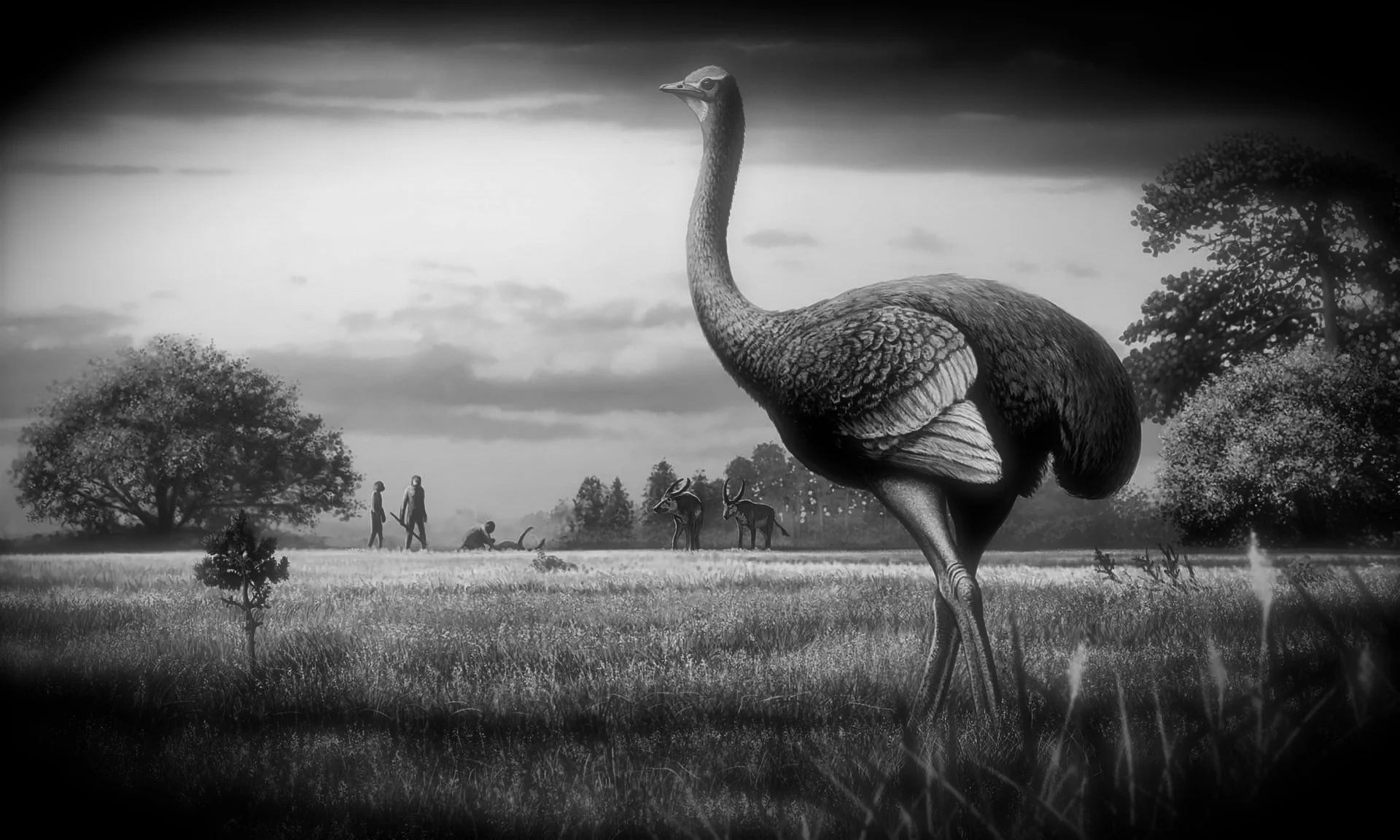
No, the more striking fact is that this early bird lived among the first Europeans — feathered cheek by early-human jowl, if you will.
The terrestrial bird roamed the Earth near the dawn of the last ice age, about 2 million years ago.
The specimen in Taurida cave on the Black Sea’s northern coast suggests a bird the size of a Madagascan elephant bird or New Zealand moa. It may well have been a source of meat, bones, feathers and eggshell for early humans.
Scientists have dubbed it Pachystruthio dmanisensis.
The discovery is the latest in a series of startling fossil finds on the Russian subcontinent, as global heating, retreating ice caps and increased human development uncover more evidence of the pre-contact world.
“We don’t have enough data yet to say whether it was most closely related to ostriches, or to other
birds, but we estimate it weighed about 450kg,” lead author Dr. Nikita Zelenkov of the Russian Academy of Sciences said, after study findings were published in the peer-reviewed Journal of Vertebrate Palaeontology. “This formidable weight is nearly double the largest moa, three times the common ostrich, the largest living bird, and nearly as much as an adult polar bear.”
A mighty big bird, in other words.
Pachystruthio dmanisensis may have been flightless, but it was fast, the evidence suggests. Elephant birds were hindered by their bulk when it came to running, but the relatively long and slim femur of the recently discovered bird suggests it was built more like a sprinter than a more sedentary bird. Interestingly, palaeontologists also found fossil evidence of highly-specialized large carnivores of the era alongside the bird’s remains, carnivores like the sabre-toothed cat and early, much larger ancestors of the cheetah and hyena. That suggests the bird’s speed was adapted over time to outrun predators — flight, rather than fight.
The Russian Science Foundation has been taking a lead role in paleontological science of late. The recent find suggests the giant bird, though previously neglected by science, was probably typical of wildlife found at the time the earliest hominids found their way to Europe during the early human migrations out of Africa.
Big Bird has gone mainstream: The Crimean findings have been reported in Scientific American, New Scientist, Smithsonian, Live Science and National Geographic in recent days, alongside mainstream news outlets CNN, BBC World, ITV, The Independent, Newsweek and The Guardian, among others.
Pachystruthio dmanisensis has come back to life.

©Nikita Zelenkov-Society of Vertebrate Palaeontology