
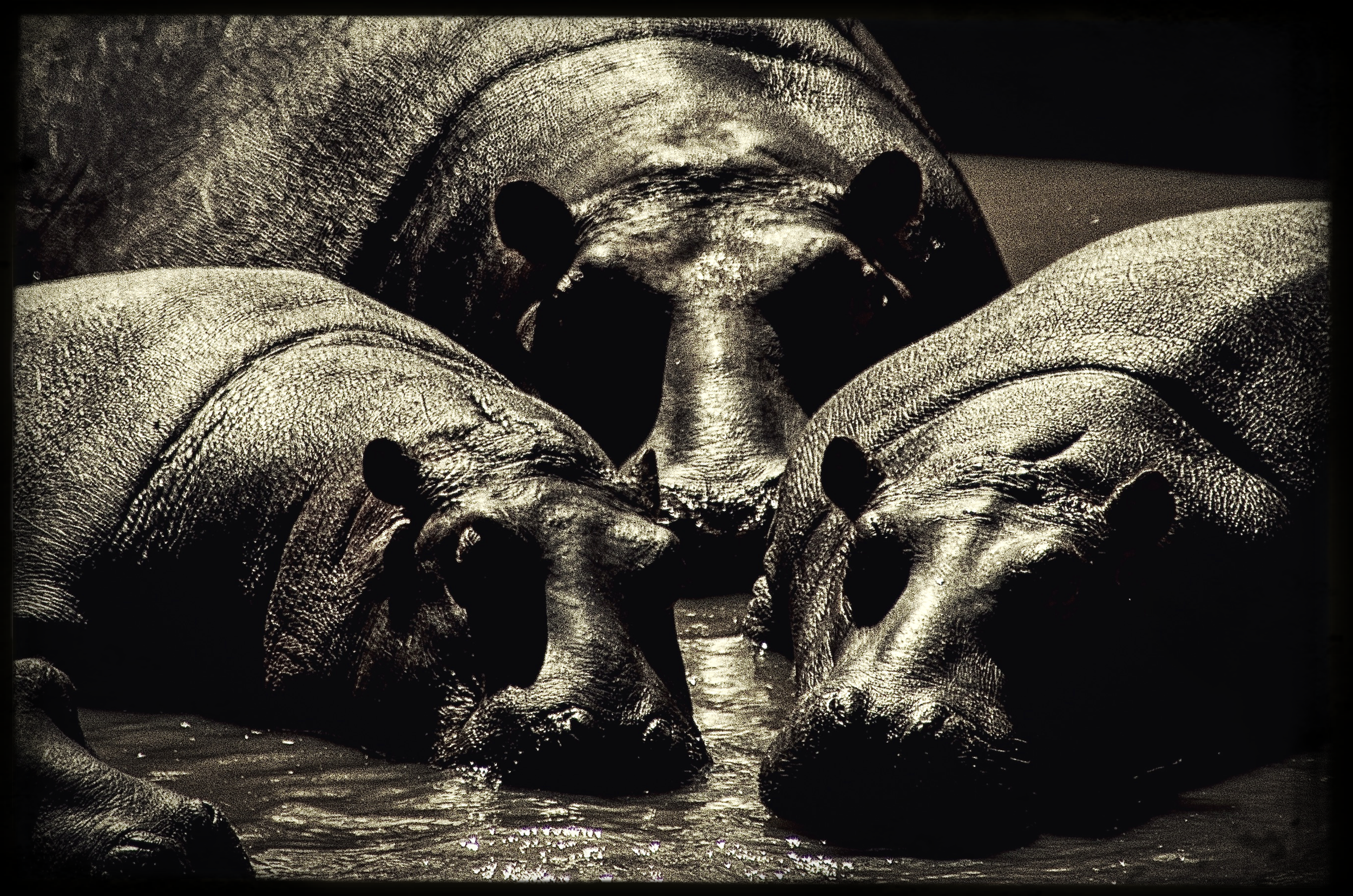
Hollywood has a lot to answer for. The myth of hippos as Peter Potamus, for example, goofy lovable creatures who time travel in hot air balloons and wear tutus and pointe shoes to the ballet. The reality is quite different.
The know-it-all was determined to set the record straight. He had downed one too many sundowners — heavy on the gin! — and the heat and humidity of equatorial Africa weren’t helping.
“I will have you know,” he began, “that hippos kill more people in Africa than any other animal!”
“Well …” Musonda, our erstwhile guide with Zambia’s Dept. of National Parks and Wildlife (DNPW). replied calmly. “That isn’t entirely true.”
He returned the know-it-all’s angry, red-faced glare with the calm mien of someone who knows what he’s talking about.
After all, when a wild animal goes rogue and kills someone, as happened just days earlier in another park in a neighbouring country, Musonda would have been one of the frontline workers expected to go in and clean up a terrible mess.
“There’s the clever, too-smart-for the-room answer,” Musonda said. “Mosquitos.
“Which happens to be true … but that’s overthinking things, at least what we’re talking here. Easy on the gin there, fella.”
Perhaps, deep down, he was rethinking the whole idea of Zambia being one of the few countries in sub-Saharan Africa to allow — encourage, even — supervised walks in the miombo wilds. The key word here being supervised.
“Crocodiles,” he added, channeling his inner Graduate. “I have just one word. Are you listening? Crocodiles.”
Exactly how do you mean?
“For the simple reason they don’t leave a trace,” Musonda said matter-of-factly. “Folks just vanish. It’s hard to tell just how many sisters and brothers are taken by crocodiles. Crocodiles don’t leave any evidence behind. People simply just disappear.
“Of the large land mammals, it’s true that elephants kill more people — but that’s around the world. Hippos are only here in Africa.”
Pablo Escobazr notwithstanding.
Whatever you do, don’t run, goes the familiar refrain. As refrains go in the wild, it works. Most of the time.
With lions, for example.
Hippos? Not so much.
With hippos, the sage advice is to go for the nearest tree, and even that doesn’t guarantee a successful escape.
Hippos are faster than they appear, and their temper is legendary. Myuthical, even. If there was a competition for the most bad-tempered animal on the planet, hippos would be the one most likely to start an argument in an empty room.
Predators are all about food — you’re just protein to them — whereas hippos, being primarily vegetarians — the precise clinical, scientific term is “opportunistic omnivores” — are content to munch happily on tall grass, which they do mostly at night, on dry land, chowing down as much as 50 kg (110 lbs) in a single night.
Night being the operative word.
Hippos prefer to eat in the dark. They don’t graze during the day — that’s why you don’t see many images or videos of them on dry land — and, contrary to general assumption, they don’t care for lily pads and other aquatic vegetation. They’re almost entirely grazers, which they do at night.
Hippos are also notoriously insecure, and territorial to a T. That can be a bad combination.
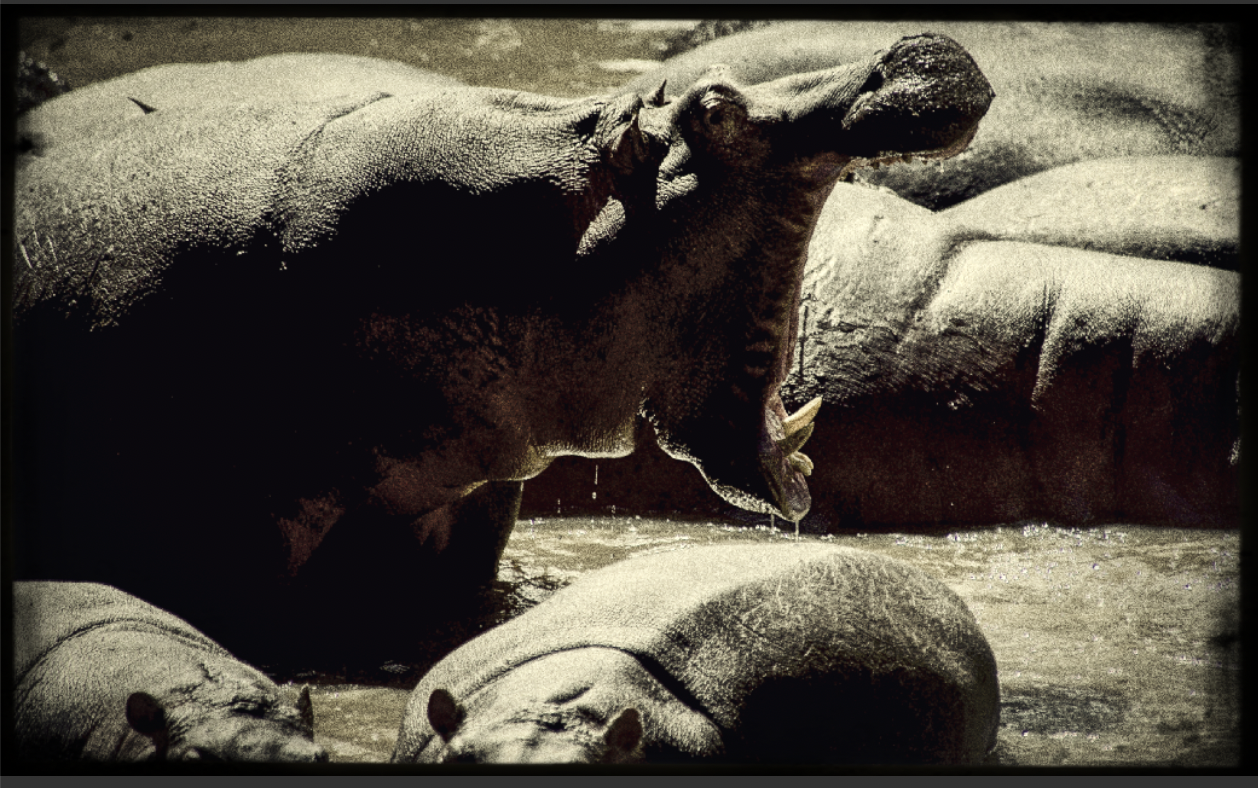
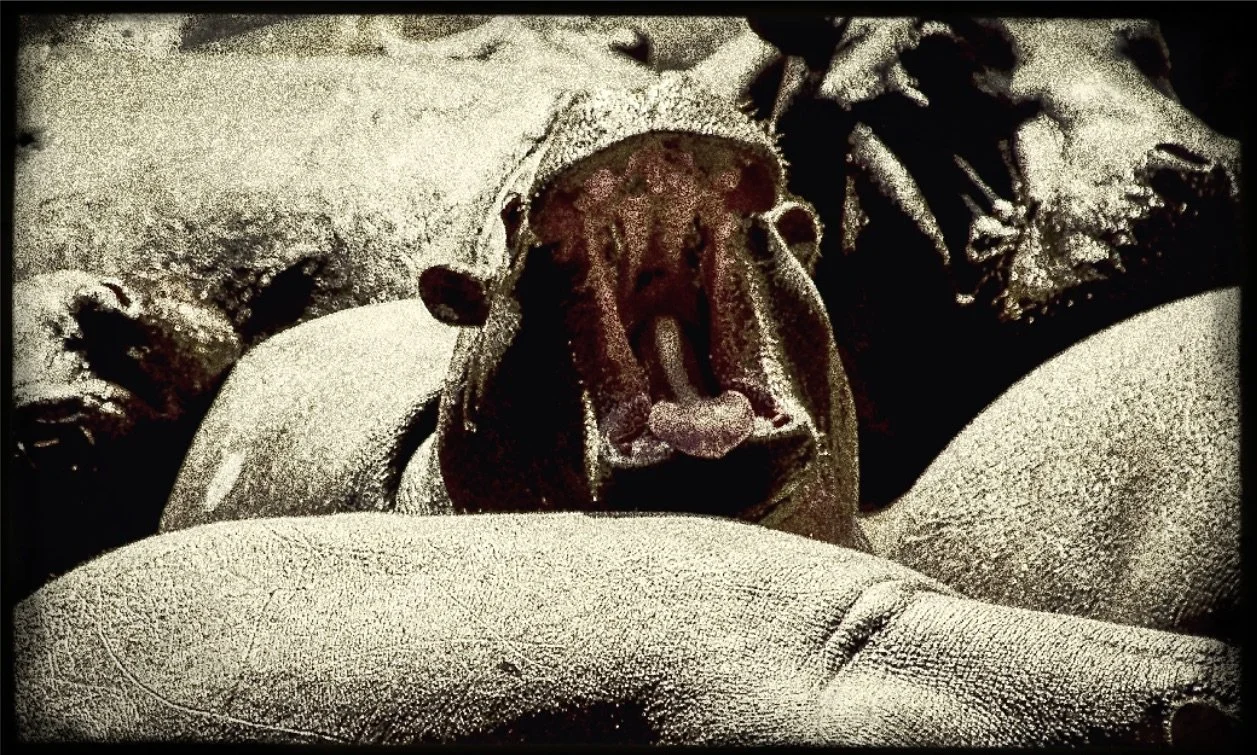
Male hippos in the wild are often deeply scarred, usually from territorial disputes with other hippos. A hippo’s yawn is actually a territorial threat display, to better to show off their 50 cm tusks with. (Think 20 inches in American money.)
Hippos have a bone-crushing bite, too. A hippo’s bite force is 1,800 PSI, three times that of a lion’s, give or take.
Hippos feel safe and secure in water — it’s their happy place. If you get between a hippo and water, at night, alone, on foot, God help you — though, in the event, more likely not.
©Alex Strachan/Strachan Photography
You have a problem. A big problem. In this case, size matters.
This is not helped by the fact that hippos range over surprisingly long distances at night, searching for the most succulent grass.
Despite their bulk and seemingly short stumpy legs, they can move. When they work themselves into a rage, which is early and often, they can top 30 km/h (18 mph). Unless you’re Usain Bolt, or Noah Lyles for that matter, you haven’t much of a chance — and not even Bolt is likely to register his top time in tall grass in the pitch dark of night.
As with any large, potentially dangerous large animal in the wild, as Musonda took pains to point out, a little common sense and an abundance of caution go a long way. Respect for the natural world and an appreciation of the ways of the wild help too.
Hippos kill around 500 people a year, according to most estimates. (Crocodiles are estimated to kill 1000 or more people each year, but as has been established, they don’t leave much evidence behind). Scientists and wildlife researchers calculate human fatalities from hippos using hospital records, park ranger reports, and area community surveys. Most if not all fatal attacks — hippos and crocodiles alike — occur in remote areas, so researchers use population-density scaling to project regional numbers to draw broader continent-wide conclusions.
Given the facts on the ground, then, it’s only fair to ask why hippos have earned a reputation for being friendly, cuddly critters who like to laugh, dance, and have a good time.
The culprit, as is so often the case, is Hollywood.
First — or if not first exactly, the first I can remember anyway — was Hyacinth Hippo in the Disney feature-length ‘toon classic Fantasia, circa 1940.
Hyacinth, a prima ballerina, famously wore a tut and sported a gold coloured tutu and matching golden ballet slippers in the classic ‘toon’s ‘Dance of the Hours’ segment.
Then there was Peter Potamus, a 1960s cartoon character known for his time-travelling hot air ballon and his signature “hippo hurricane holler.”
Followed in short order by George and Martha, titular stars of the children’s book series, and Tootsie, the “Hungry Hungry Hippos” character from the popular board game.
More recently, we’ve had Gloria, the sassy, level-headed hippo at the centre of the Central Park Zoo crew in the original animated film Madagascar, and Moto Moto, the smooth-talkin’ larger-than-life hippo who loves to ”name things twice” in the Madagascar follow-up e Madagascar: Escape 2 Africa.
The experts — yes, there are experts in this kind of thing — say hippos are often depicted as cute, cuddly, friendly critters in popular culture because their chubby, rotund shapes trigger a human psychological response called "baby schema,” or neoteny.
Now you know.
As we’ve now shown, the reality is quite different. Hippos have earned a deserved reputation as one of nature’s more dangerous large land mammals, but as the PBS science and natural history program Nature has gone to great lengths to point out, their aggression is more a result of anxiety and the primal need to defend their turf than outright belligerence and contrariness.
Doesn’t mean they shouldn’t be taken seriously, though.
As the scholar Md. Ziaul Haque once said, “A crocodile and a hippopotamus can never be friends.”
©Alex Strachan/Strachan Photography