

Nothing grows in the desert, goes an old refrain on the late-night comedy circuit: That’s why they call it the desert.
That’s not exactly true, of course, though it makes for a good laugh line. The reality, as the fourth instalment of the aptly named The Green Planet shows, is that desert worlds are a virtual garden of vegetation: One simply has to know where to look. Of all the episodes in the eye-filling nature series so far, Desert Worlds is the most adroit at showing how the hardiest plants find extraordinary ways to survive Charles Darwin’s battle of the most adaptable, even though water may be scarce to non-existent and temperatures can swing from one wild extreme to another, all in the course of a 24-hour day. There are plants that cling to a tenuous existence by slowing their metabolism to a murmur over lengthy periods of time, while others slither and crawl across the parched land, in an endless search for water.
Some plants hibernate — literally — and come to life in explosions of color at the first hint of rain, while others adopt defensive postures to protect themselves from grazing animals, defensive postures that can involve anything from camouflage to razor-sharp spines. Desert landscapes, including those more aptly described as sandscapes, look harsh and unforgiving in the bright light of day, but look beneath the surface and you’ll find a world of hidden surprises. Desert Worlds opens in northern China, flowing over a sandscape of desert dunes — and, just when you least expect, a grove of trees that has survived more than a thousand years, linked together by a labyrinthine web of unde4ground roots. From China to Mexico in a heartbeat in TV time, the camera sweeps around the gentleman naturalist David Attenborough, now 90, wending his way on foot through a dune sea where it may rain once a decade. There’s a gentle peace and world-lived soul to the way Attenborough talks about the private lives of plants, and what’s truly remarkable is how, even after Planet Earth and a lifetime’s service at the forefront of BBC’s Natural History Unit, he has maintained an almost childlike sense of wonder at the mysteries revealed before him. Not unlike a desert wind, Desert Worlds moves gently but restlessly to the Atacama desert in Chile, then the Kalahari in southwest Africa, followed by the Sonora in the southwestern United States, and everywhere he goes, Attenborough finds something wondrous.
There are almost two thousand different species of cactus, for example, a fact that may come as a surprise to anyone who isn’t a career botanist, and every cactus has a story. These stories are what drives The Green Planet, just as it was stories that drove Blue Planet and Life on Earth before it. Nature is complex, magisterial and full of hidden surprises, and that’s why the stories in The Green Planet never seem tiresome of formulaic. Far from. Watching weeds grow may be the very definition of boredom, but one of Desert Worlds’ singular achievements is how it makes watching weeds grow in one of the driest, hottest, most rugged and inhospitable biospheres on the planet is as gripping as any Netflix cliffhanger.
There’s a memorable moment, midway through the program, when the scene flashes back 40 years to The Living Planet, in which a younger, more svelte Attenborough, stands in California’s Mojave Desert, searching, in his words, “for one particular plant,” the creosote plant, Larrea tridentata.
The scene then flashes forward to present day, and Attenborough is standing over that very same bush. In 40 years, it has grown precisely one inch.
Watch Desert Worlds and you may never look at the desert the same way you again.
The Green Planet: Desert Worlds premieres Wednesday, July 27, on PBS at 8E/7C and on the PBS app. The final episode, Human Worlds, airs on Wednesday, Aug. 3.
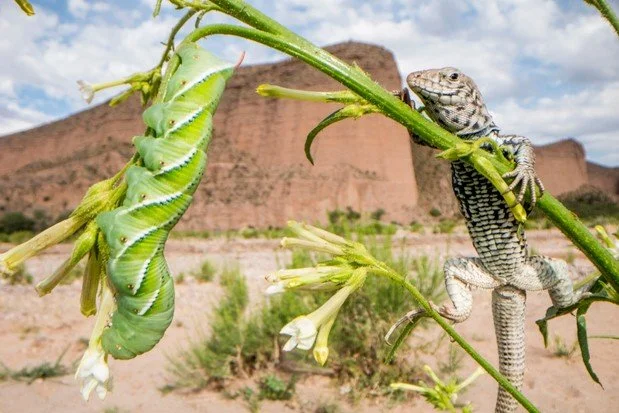
©BBC Studios