
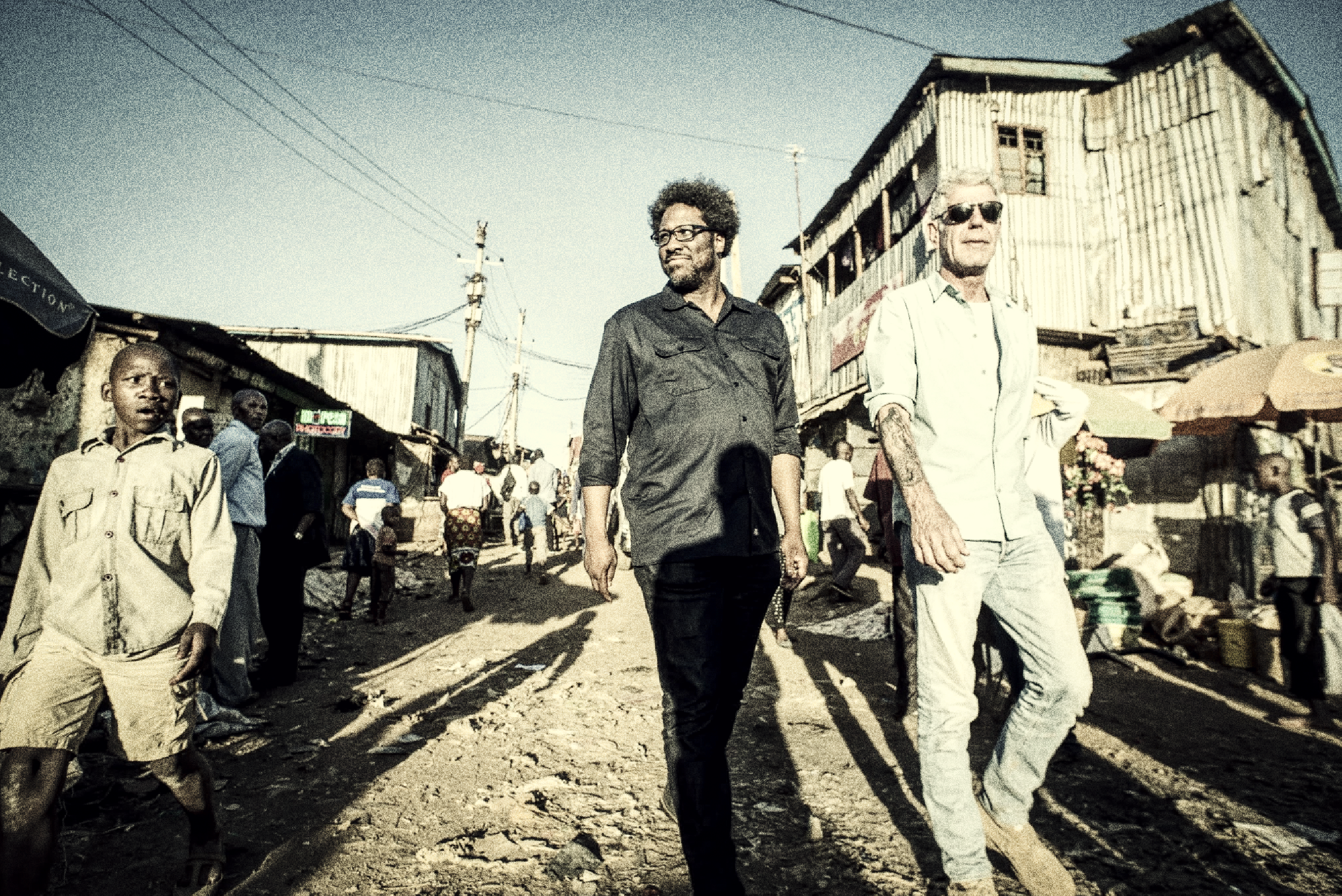
“What a shit-hole,” Bourdain said with a rueful laugh and no small amount of sarcasm, alluding to a certain US president, as he took in the stirring, spectacular sight of Kenyas’s Lewa-Boran wilderness, alongside his friend and travel companion W. Kamau Bell.
What he said next would reveal Bourdain at his most pensive, reflective self.
I never cared much for the words ‘funeral’ or ‘wake.’ A friend prefers the more poetic “celebration of life,” and on this anniversary of a life passed,
I prefer to take this moment to remember Anthony Bourdain in life, and remember what made him a voice of the world … for the world.
Bourdain himself would have been appalled by such maudlin and gauche sentiment. Sentimentality was not for him, though he could cry privately over injustice and cruelty to good, decent people with the best of them. Making a spectacle of himself in public after his passing would be anathema to him. It would have left him feeling embarrassed and irritable. Caustic, even. And witty.
For Bourdain was at his best — and most real — when he was leaning against the tide of popular convention. ‘Get a grip, people,’ I can picture him saying. ‘I mean, for f**k’s sake, it’s not like I’m important or anything.’
From Anderson Cooper to Christiane Amanpour to Barack Obama to the folks who follow him to this day on Tony Donato’s Anthony Bourdain Facebook page, everyone was the same in his eyes, celebrity and non-celebrity alike.
And equal.
For that was one of his unique gifts. He always saw the best in people, regardless of who they were.
For that is who he was, deep down. He lived his life in the moment, by moment,
And when someone stepped out of line, whether that person was merely a lost soul living on the margins or a head of state found to be profoundly lacking in integrity, dignity, humanity, judgment or even an ability to just do the job you’ve been elected to do, Bourdain would call him on his s**t, as he might say — and often did.
Everyone who discovered Bourdain can recall that moment with a unique clarity, as though it were yesterday.
For me, it was Africa.
I was on one of those 12-hour night flights, flying high above over the Democratic Republic of the Congo (DRC), where all one could see from the window of a Lufthansa Airbus was darkness and bursts of sheet lightning momentarily lighting up the clouds below, sheet after sheet after sheet of lightning in the darkness, mile after mile after mile, as far as the eye could see. And below the clouds, one of the world’s last surviving, primeval rainforests. This is Africa, and for me it was out of this world.
During his lifetime, Bourdain took in Madagascar and Senegal in his own unique way, alongside companions like the filmmaker Darren Aronofsky (you may know him from films like Requiem for a Dream and The Fountain, and then again, maybe not) and the poet-philosopher and musician Youssou N’Dour; Ethiopia, with the chef Marcus Samuelsson; and so on.
Nigeria. Libya. Maroc. Rwanda. Ghana, for No Reservations, along with Liberia, Mozambique, and Namibia, a country I know well.
Parts Unknown’s Kenya, the premiere episode of the show’s 12th — and final, as it would turn out — season, is distinct on so many levels, not least because it was the first season-premiere episode to air after Bourdain died by his own hand on 8 June 2018, in the town of Kaysersberg Vignoble, France, at age 61.
Bourdain was filming an episode for Parts Unknown at the time, ironically enough, alongside his close friend and occasional Parts Unknown sidekick Éric Ripert.
(Parts Unknown Kenya was the first season premiere to air after Bourdain’s passing, but not the first standalone episode. Berlin, Cajun Mardi Gras and Parts Unknown’s 11th-season finale Bhutan, with its rumination on Old World wisdom and coming to peace with the afterlife, all aired in the weeks following. The episode Hong Kong, with its not inconsiderable emotional baggage — and I’ll leave it at that — aired just five days before Bourdain’s suicide.)
Kenya was distinctive, too, because unlike many episodes in which Bourdain was the sole focus, Kenya was driven by Bourdain’s companion W. Kamau Bell, raconteur-philosopher and stand-up comedian with his own CNN show at the time, United Shades of America, as he experienced his first visit to Africa and explored his emotional connections to the continent of his ancestors as an African-American.
Together, the two would tackle the “White Saviour” complex, engaging in candid, often uncomfortable conversation about socio-political dynamics and economic colonialism — the second-hand clothing industry, to cite just one example — and take a close, unflinching look at Nairobi’s vibrant urban culture as embodied by the township of Kibera.’
It’s the ending, though, that final poignant soliloquy toward the episode’s close that had viewers, as one viewer sop aptly put it at the on Reddit, “in bits.”
That soliloquy, first in quiet conversation as Bourdain and Kamau Bell sit alone atop a vast escarpment overlooking the silence of the African wilderness, and later in voiceover, would be Bourdain’s final witness statement.
From Kenya’s Lewa Wildlife Conservancy in the heart of northern Kenya’s Lewa-Boran wilderness region, to the hardscrabble back lanes of Nairobi’s Kibera township, this was Bourdain at his most reflective.
What better way, then, to close than with Bourdain’s own words:
“I will tell you,” he told Kamau Bell, “I got 17 years (of this). As soon as the cameras turn off … and the crew, we’ll be sitting around … having a cocktail … I’ll f**king pinch myself. I cannot f**king believe that I get to do this. Or see see this. Ever. That I ever would.
“Because, at 44 years old, dunking fries, I knew, with absolute certainty, that I would never, ever, ever see Rome, much less this.”
And then, minutes later, at the close, with Kamau Bell in Kibera…
“All of us, when we travel, look at the places we go, the things we see, through different eyes. And how we see them is shaped by our previous lives, the books we’ve read, the films we’ve seen, the baggage we carry…
“Who gets to tell the stories? This is a question asked often. The answer in this case, for better or worse, is, ‘I do.’ At least, this time out.
“I do my best. I look. I listen. But in the end, I know … it’s my story, not Kamau’s, not Kenya’s, or Kenyans’ … “those stories are yet to be heard.”
Anthony Michael Bourdain.
25 June 1956 to 8 June 2018.
Gone but never forgotten.
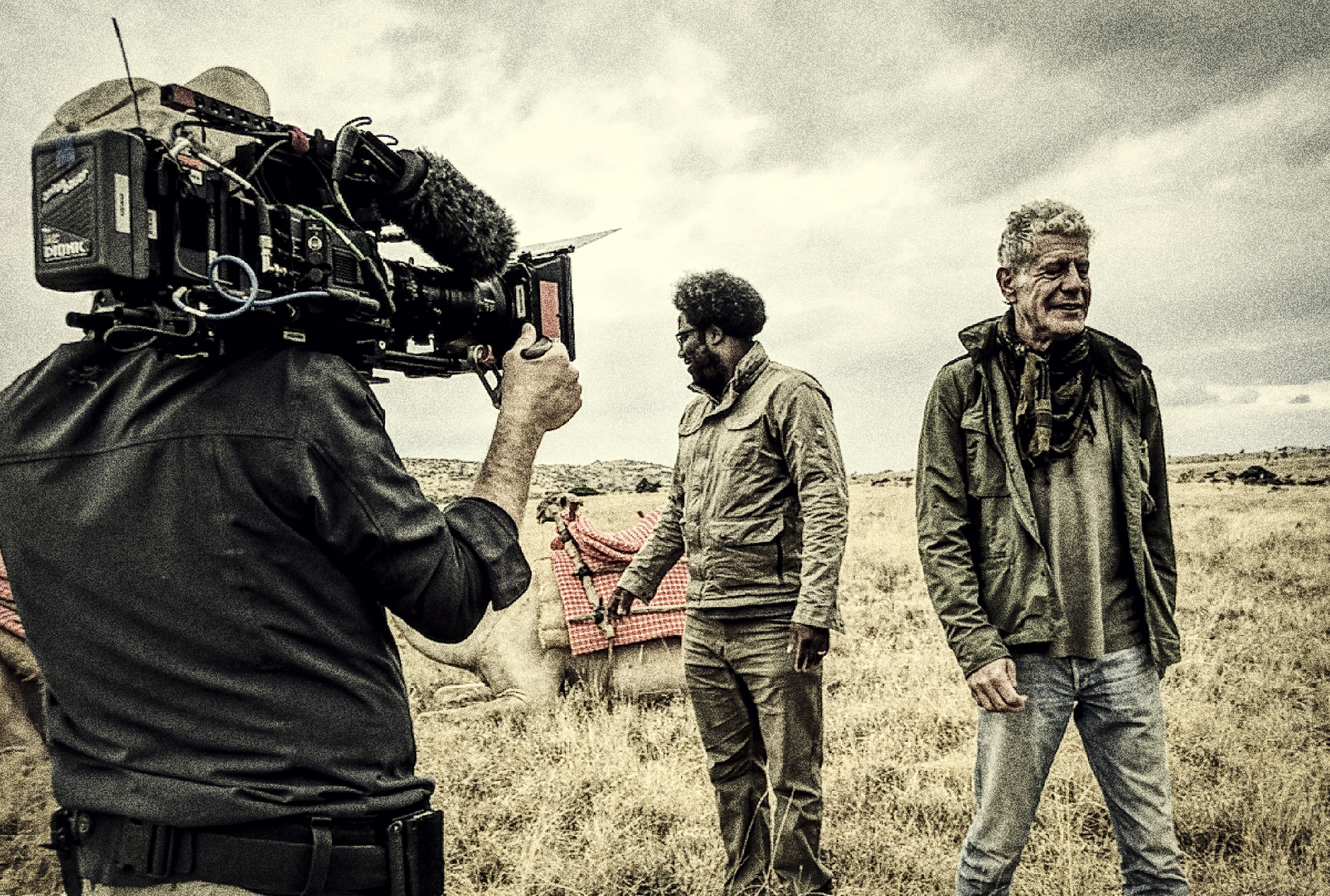
Photo: Morgan Fallon/CNN