
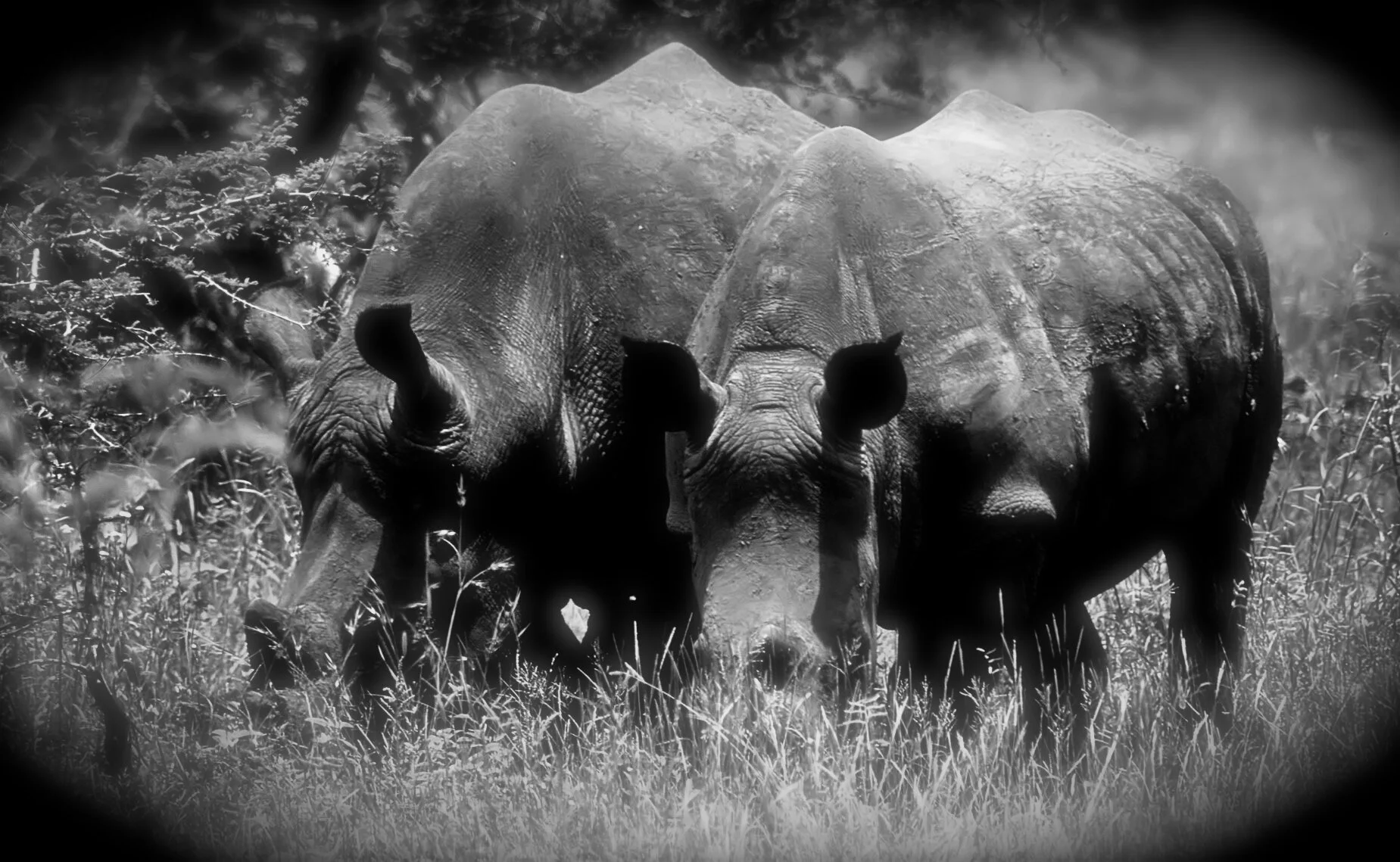
“The first priority for all rhino conservationists should be to ensure adequate anti-poaching monitoring and security (including intelligence-gathering) to protect rhino populations, and only then should dehorning be considered. For is a rhino really a rhino without its horn?”
Violent but bloodless, dehorning is considered a necessary evil by anti-poaching campaigners in South Africa, the heading in a 2018 essay, reprinted this past week in The Guardian, noted.
The idea is not new — it wasn’t even new in 2018 — but it has gained currency during the recent spike in poaching due to Covid lockdowns and the accompanying crash in conservation funding and cuts to law enforcement in national parks and private wildlife reserves throughout Africa.
The essay, by Durban-based environmental journalist Tony Carnie, is well-researched, fact-checked and covers a lot of bases — including, for example, the care taken to prevent pain to the rhino, in much the same way one needs to be careful when trimming a cats claws, and why de-tusking elephants can’t and won’t work the way it does with rhinos and their horns. It’s a solid, succinct article, and well worth reading, whether one is up-to-speed on the latest campaign to save one of Earth’s most striking living relics of a past age or just curious about an animal we’re all familiar with from childhood and its prospects for short-, mid- and long-term survival.
Trying to trim the illegal trade in rhino horn using education and basic common sense does not appear to be working; old prejudices, traditions, misconceptions and misinformation die hard. Certain cultures are determined to stockpile ivory and rhino horn, regardless of the cost to the environment and biodiversity, and they’re determined to kill every living elephant and rhino that they can to accomplish their goal.
Self-interest is a powerful motivator, though. And if a rhino doesn’t have a horn to begin with, the risk of being caught — the illegal wildlife trade is still, well, illegal and punishable by law, in theory anyway — outweighs the gain.
South Africa, hard hit by the Covid-19 pandemic, is a special case because, despite the recent surge in poaching, it is still home to the world’s largest surviving population of wild rhinos. That means something, because the rhino isn’t just a prehistoric being — a living, breathing throwback to the Pleistocene Age — but it has fired the human imagination since Roman times, when Gaius Plinius Secundus — Pliny the Elder to you and me — penned his Natural History, believed by some to be the first encyclopedia ever written.
The rhinoceros, Pliny wrote, is a natural-born enemy of the elephant. “It prepares itself for … combat by sharpening its horn against the rocks.”
Well, just not so, but Pliny was writing in AD 70.
Besides, he got other parts right. “We learn from modern naturalists that the two-horned species is a native of the southern parts of Africa, while that with one horn is from Asia.”
Rhinos are a sworn enemy of the elephant, Pliny insisted.
“The other enemy is the dragon, as described in c. 11 and 12 of the present book,” Pliny continued.
The rhino is one of the so-called Big Five, the five African animals traditionally considered by big-game hunters to be the most difficult animals to hunt, but this near-sighted, short-tempered relic of a past age also has its admirers. The New Big 5 project, a campaign to name the five animals most sought after by nature photographers — boosting those animals’ prospects for survival in a world where wilderness habitat is dwindling by the day — shares some fascinating facts about rhinos on its website at newbig5.com.
In Africa, for example, rhinos are often found snoozing during the day on particularly hot days, lying in shade beneath a big tree or shrub. They come out at night, suggesting that, despite a reputation for poor eyesight, their night vision is not too shabby. The name ‘rhinoceros’ comes from the Greek, rhino (nose) and ceros (horn), or ‘nose horn.’ The white rhino is not white but rather grey; the name ‘white’ is a bastardization of the Afrikaans word for ‘wide’ (wye), and refers to the white rhino’s distinctly wide lower jaw. The black rhino, similarly, is not black but would be more accurately named the hook-lipped rhino, owing to its more pointed snout and overbite. Black rhinos have a reputation for being more irritable and short-tempered than white rhinos, and the two do not get along.
It’s worth noting that, not so long ago, there were many thousands of rhinos roaming the planet. Half a million rhinos are believed to have lived across Africa and Asia at the turn of the 20th century; today, fewer than 29,000 remain, spread across five species and sub-species in Africa and Asia.
Incredibly, rhino horn — basically, hardened keratin — is still used in traditional Chinese medicine, even though it has been shown time and time again that rhino horn has no medicinal properties whatsoever. Species extinction is an awfully high price to pay for superstition.
From that point of view, dehorning rhinos — while expensive, time consuming and inherently risky, to both animal and person — seems the right thing to do. In an imperfect world, there are rarely easy choices.
