
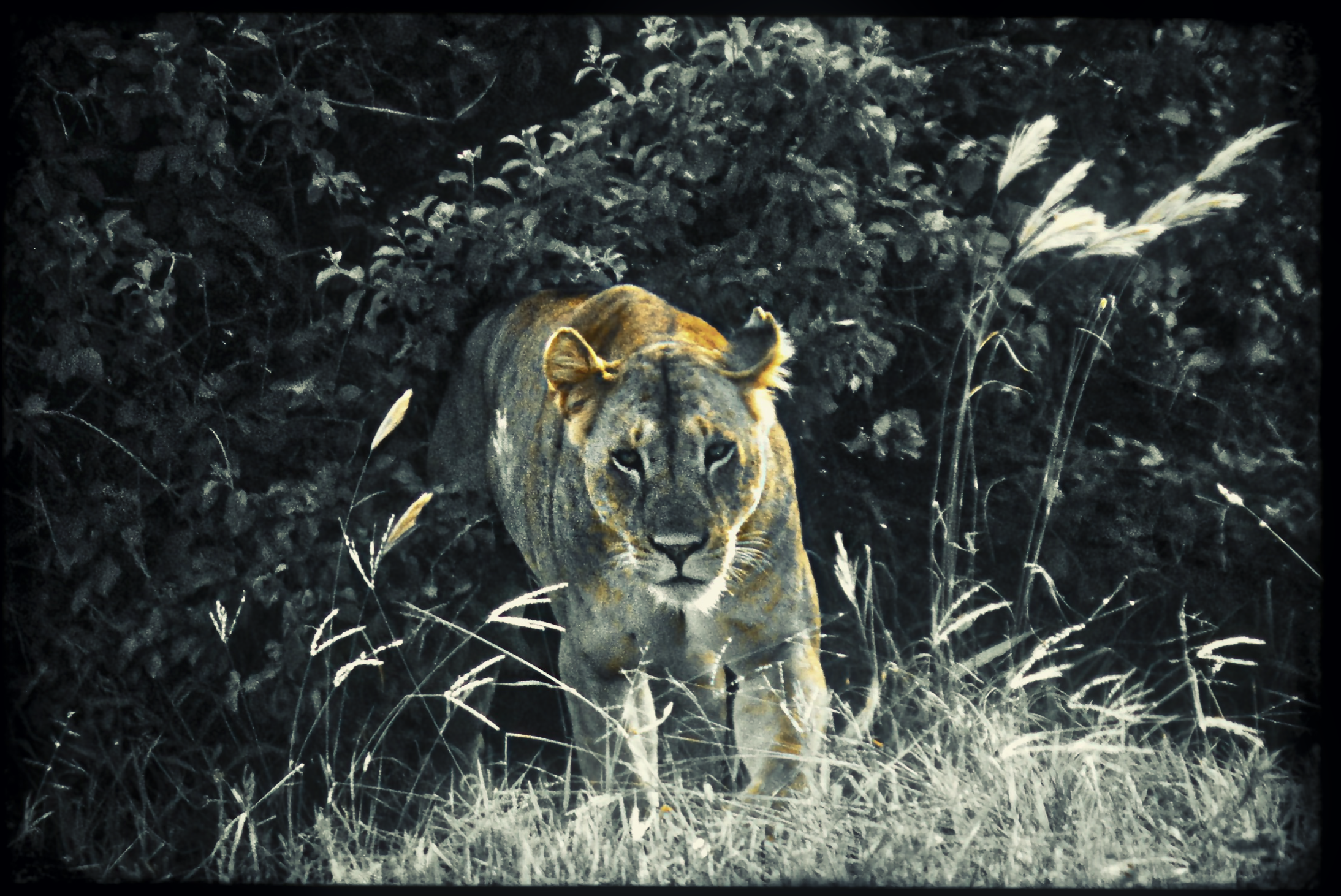
Tsavo’s lions have a formidable reputation to this day, more than 125 years after a pair of man-eating lions stalled construction of Tsavo’s aptly named “Lunatic Express” rail line.
Therein lies a tale.
Picking up where we left off … for here lies a tale of sleepless nights and the stuff nightmares are made of. They mostly come at night … mostly, goes the old line.
In the dry text of academic accounts of the not-so-recent past, the Tsavo Man-Eaters were a pair of preternaturally large, maneless lions, nicknamed “Ghost” and “Darkness” by their victims, as the lions took on a reputation of almost mythical proportion. For nothing seemed to stop them, neither man nor other beasts, as they raided labourers in their tents at night and carried them off into the dark and … well, you know.The ill-fated rail line would go on to be dubbed “the Lunatic Line,” for the sheer lunacy of building a rail line through some of the most wild, untamed terrain in colonial Africa. Never mind untamed, these lions were untameable.
Not only that, but they seemed to have an uncanny sense for the uncanny, not just evading pursuit and capture but seeming to revel in the sheer stupidity and incompetence of humans — including, but not limited to, the so-called “Great White Hunters” sent in to deal with them.
The Lunatic Line was intended to link the Indian Ocean port city of Mombasa with Lake Victoria, deep in the heart of Central Africa, through the railhead of Nairobi, some 925 km (575 miles) inland from the sea as the vulture flies. The vultures did a lot of flying between March 1898 and December 1899.
The British colonial administrator of the time, Sir Frederick Lugard DSCO, had established the headquarters of the Imperial British Africa Company deep inside Uganda in Central Africa’s Great Lakes region.
The seat of British power and influence was established at Akasozi K’empala, “Hill of the Impala” in the local Luganda language. K’empala was later shortened to simply “Kampala,” as it is known today.
K’empala was traditionally a hunting reserve for the Kabaka king of Buganda, dating back well before Pre-Contact times. Under the auspices of British colonial administration, Kampala would go one to become the locus of European trade for the whole of Central Africa. The Lunatic Line would, in theory, provide a vital trade link to the Indian Ocean, and from there across the sea to Arabia, Asia, and China. And to Europe itself, by following the sea route south using the sea route around the Cape of Good Hope, 12,500 km (roughly 7,700 miles) to the south, on the 34th parallel.
K’empala may have founded as a traditional hunting reserve for Kabaka blue-bloods but just 10 years after Sir Frederick, holder of the Most Distinguished Order of Saint Michael and Saint George (GCMG), it was a pair of marauding maneless lions that did most of the hunting — of humans brazen and rude enough to intrude on their own traditional hunting grounds. And, as anyone who knows Tsavo knows all to well, food is not easily found in such arid, unfriendly terrain — hence the nickname Starv-o. The lions, twice the size of “regular lions,” could scarcely have believed their luck. Nighttime and the livin' is easy.
More used to tangling with buffalo, anywhere from 400kg (930 lbs) to 900kg (2,000 lbs) of sheer anger, not to mention the thickest hide this side of a 3.5 ton rhino (3,200kg in English money), the Tsavo lions regarded construction on the rail line, to borrow a line from Hemingway, a moveable feast. Far better, and easier, to drag luckless workers from their tents in the dead of the night and devour them within earshot of their colleagues.
Early efforts to rein in the lions proved in vain — to put it mildly — and the situation soon deteriorated to the point where outside help was called in, as the late photographer-adventurer Peter Beard recounted in his book Zara’s Tales.
By this point, the lions — not just content with the offerings at hand — expanded their appetite to include not just railroad workers but passengers as well.
The lions evolved to become what Anthony Bourdain would describe as “culinary pirates” —diners with a fearless, open-minded attitude toward food, dedicated, like-minded and “slightly reckless” (Bourdain’s words) in the rough. Bourdain often urged travellers to be intrepid and apply the “Grandma rule” of, “Just shut up and eat it,” when offered local food.
The Tsavo lions took this to a whole other level, though. “They were known to snatch (passengers) from their costly Pullman berths in the dead of night,” Beard wrote in Zara’s Tales, “and make a disgusting meal of them.”
Disgusting!
In the end, estimates of the man-eaters’ toll range from 28 — the Uganda Railway Company had a vested interest in keeping the real count as low as possible, so their workers would not revolt … which they did anyway — to more than a hundred, which may be an overestimate but seems more reasonable given that “official: headcounts at the time tended to be haphazard and done on the fly. Daily attendance checks and carefully compiled staffing reports were not as fastidious as they might have been under normal circumstances, “normal” being a malleable concept in Tsavo at the best of times. And these were not the best of times.
As it was, the British colonial administration bid for the services of “an enthusiastic sportsman” to deal with the unruly interlopers for once and for all. That sportsman, Lt. Col. John Henry Patterson, a British Army officer, structural engineer, and recreational hunter during his days in colonial India with wide experience of hunting tigers — surely lions would prove easier — vowed to solve the problem in a “cool, calm, and collected” manner, a matter of days, surely, a week at most.
In the event, it took 10 months.
The lions proved to be moody, unpredictable, irascible, and frighteningly intelligent, with a sixth sense for sensing where there might be trouble, and avoiding it — instead striking where least expected, up and down the rail line, time and time again, at all hours of the night and early morn ing — and, in time, in broad daylight as well.
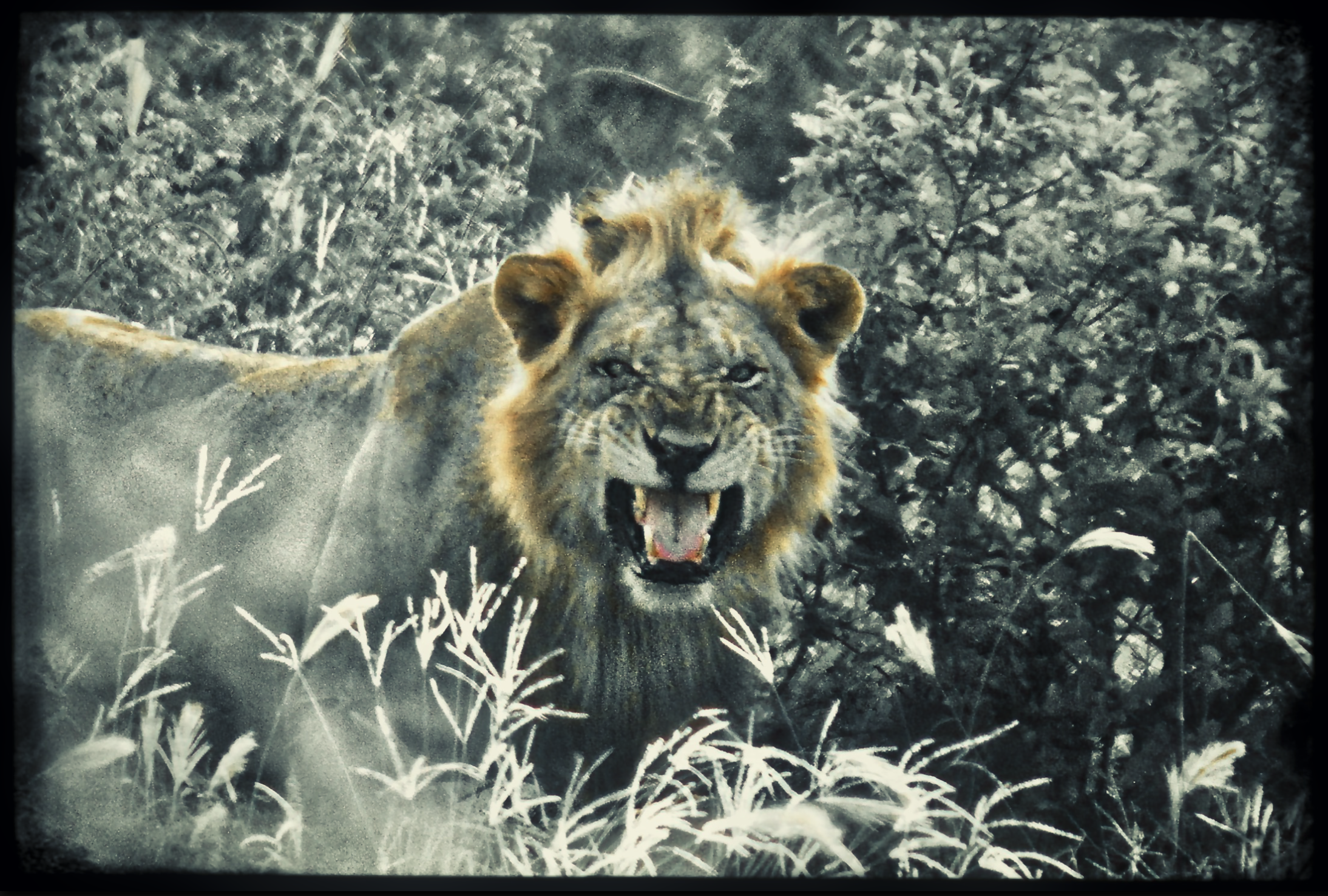
©Alex Strachan / Strachan Photography
Sometimes they acted alone, sometimes as a pair. They would attack at one point one night, then attack miles away the next night. At one point, they even attacked a field hospital. They evaded lures, broke out of a box trap — reinforced with iron bars — and on the one occasion they fell for a ruse, they broke their way out of their cage and the Great White Hunter sent to shoot them had his gun jam at a most inopportune moment.
These lions were becoming mythical beasts, the stuff of legend, and their uncanny pursuit of humans did not endear them to local villagers, or do much for morale among the rail workers. All-out rebellion ensued, and Lt. Col. John Henry Patterson found himself with a right old mess on his hands.
The “enthusiastic sportsman” was losing his enthusiasm for the chase; perhaps it was time to retire to the comforts of damp, boring Merry Olde England and the leisurely life of a country gentleman in the Cotswolds — not … this. This nightmare of biting flies, a furnace sun, unruly locals on the verge of insurrection, and marauding lions that, as we’ve established, mostly come at night … mostly.
According to the Uganda Railway Company’s official records of the time, the final toll of “deaths by misadventure” clocked in at 28, but as Lt. Col. Patterson himself recounted in his book The Man-eaters of Tsavo (Macmillan, 1907, an instant besteller!), the unofficial number may have been closer to 135, give or take.
Social media not being then what it is today, the real number is anyone's guess.
As it happened, Patterson did eventually bag his lions — though one of them almost bagged him in the process. This time, his gun did not jam. It did, however, require nine of 10 shots, all of them direct hits, to bring the second, larger lion to heel. It just would not die. The stuff of myth and legend.
Patterson had started spending nights alone on one-man stakeouts —not a good idea — using himself as bait, often hiding — not entirely successfully — atop a ramshackle machan, a raised hunting platform made from loose bits and pieces of acacia, commiphora africana and corkwood.
The machan was so rickety it tended to bend and sway in a high wind — a lean-to … literally.
The lions took the bait, but even the it was evident from the first night that things had a way of going wrong, as they tend to do when Wild Africa holds all the cards and Murphy, of Murphy’s Law fame and (mis)fortune, is alive and well.
After several fruitless nights spent perched above his shaky, wobbly perch, Patterson got the distinct feeling he himself was being stalked in the dark. The hunter was being hunted.
In at least one sense, though, the plan was working — the part about holding himself out as bait.
When Patterson finally managed to shoot the first lion — which had indeed been stalking him in the dark — through the chest with a .303 rifle from little more than three metres (10 feet) away … the lion, simply ran off into the night, as if nothing had happened.
On one level, though, the plan was working — the part about holding himself out as bait. When he finally managed to shoot the first lion — which had indeed been stalking him in the dark — through the chest with a .303 rifle from little more than three metres (10 feet) away … the lion, and this is by all accounts true, simply ran off into the night, as if nothing had happened.
Patterson followed up at daybreak — tracking a wounded lion in dense cover being one of the more unenviable challenges a hunter can face, and not one likely to be repeated today by fat dentists from Minnesota (Cecil the lion’s killer) — and for a second time in less than 24 hours, Patterson’s ruse of holding himself out as bait worked. This was not quite the way he intended it to happen, however.
The lion, fed up by the Patterson’s impertinence and determined to even the score, charged him from the underbrush.
This time, though, luck was — finally, finally, finally — on Patterson’s side. He managed to shoot the lion in the shoulder — not what he was aiming for — but the bullet ricocheted off heavy bone and penetrated past chordae tendineae into the lion’s heart.
The second lion proved harder to kill, not that the first lion had been easy.
In the end, it took 19 days — 19 days — of tracking the lion in the dense cover and when Patterson finally caught up the lion — or, rather, the lion caught up to him — it took anywhere from six to nine shots to subdue the man-eater. According to Patterson’s diary account, even that was apparently not enough to finish the job: the lion died gnawing furiously on a tree branch lying loose on the ground.
More than century later, Tsavo lions still have a reputation.
Tsavo lions are not like Serengeti lions, the late conservationist Daphne Sheldrick once said. They don’t stretch out under a tree, “waiting for their stomachs to be rubbed.”
Perhaps it is the place itself. Tsavo is the Kamba word for slaughter, Tsavo as “the Place of Slaughter,” invoking the region's historic, often violent past involving community conflicts, the slave trade route, the Ivory Wars … and those infamous man-eating lions..
The last word, as seems only appropriate in an ode to Peter Beard, belongs to Beard himself, who like so many before him, from Karen Blixen and Denys Finch Hatton to Bill Woodley, David Sheldrick and Daphne Sheldrick, grew to regard Tsavo as a second home.
“That’s the way it was … night and day, a child’s dream, an archetypal memory that can only be conjured up on old forgotten films,” Beard wrote in Zara’s Tales. “I can still see and feel my broken-down 1960 Land Rover on river runs, driving down the prehistoric riverbed through assemblies of quietly rumbling elephants going about their eternal business, unaware of their imminent appointment with destiny.”
Beard passed on 19 April, 2020, at age 82.
The elephants’ appointment with destiny has yet to be written. The lions, too, for that matter.
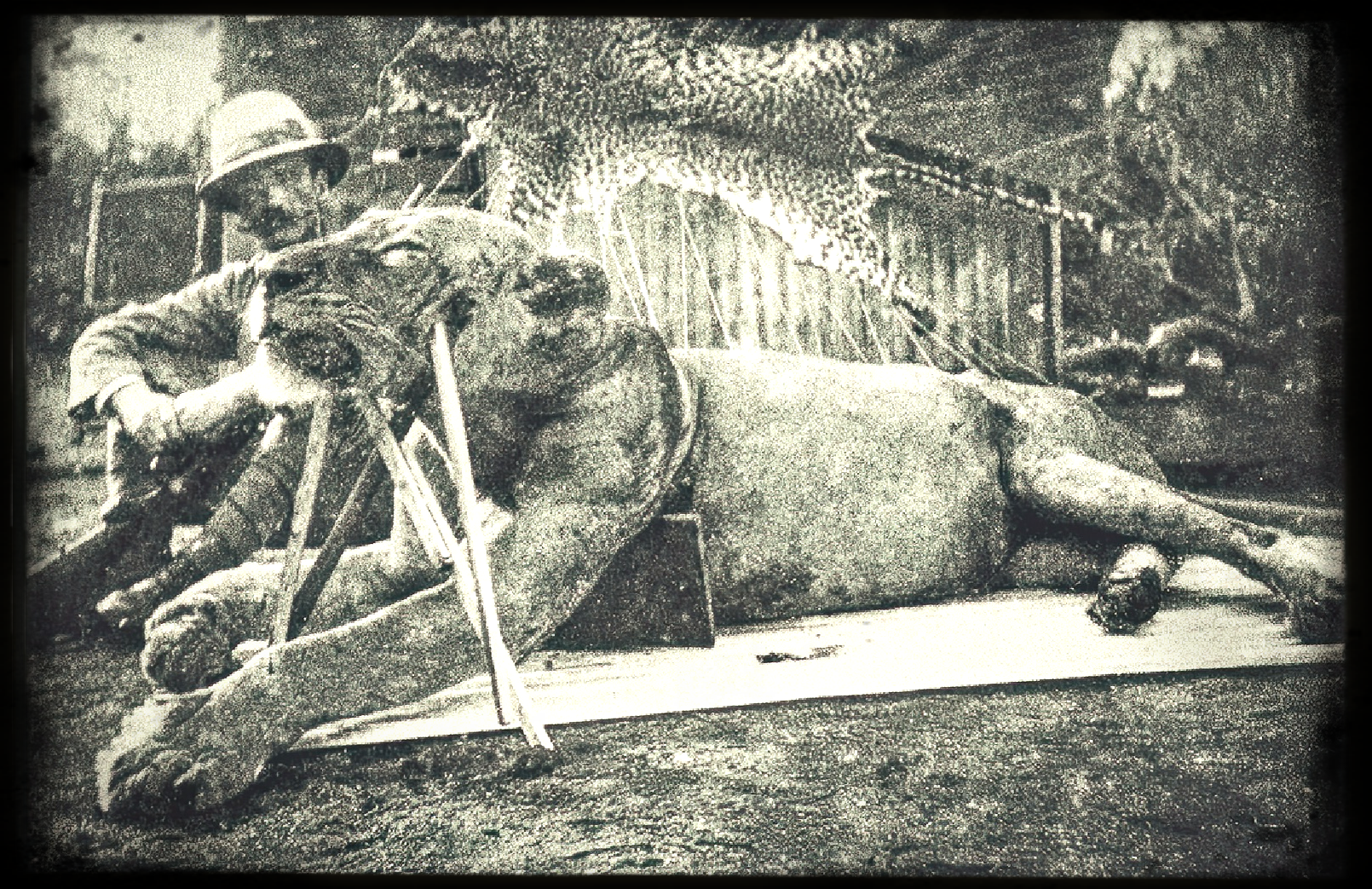
Getty Images