
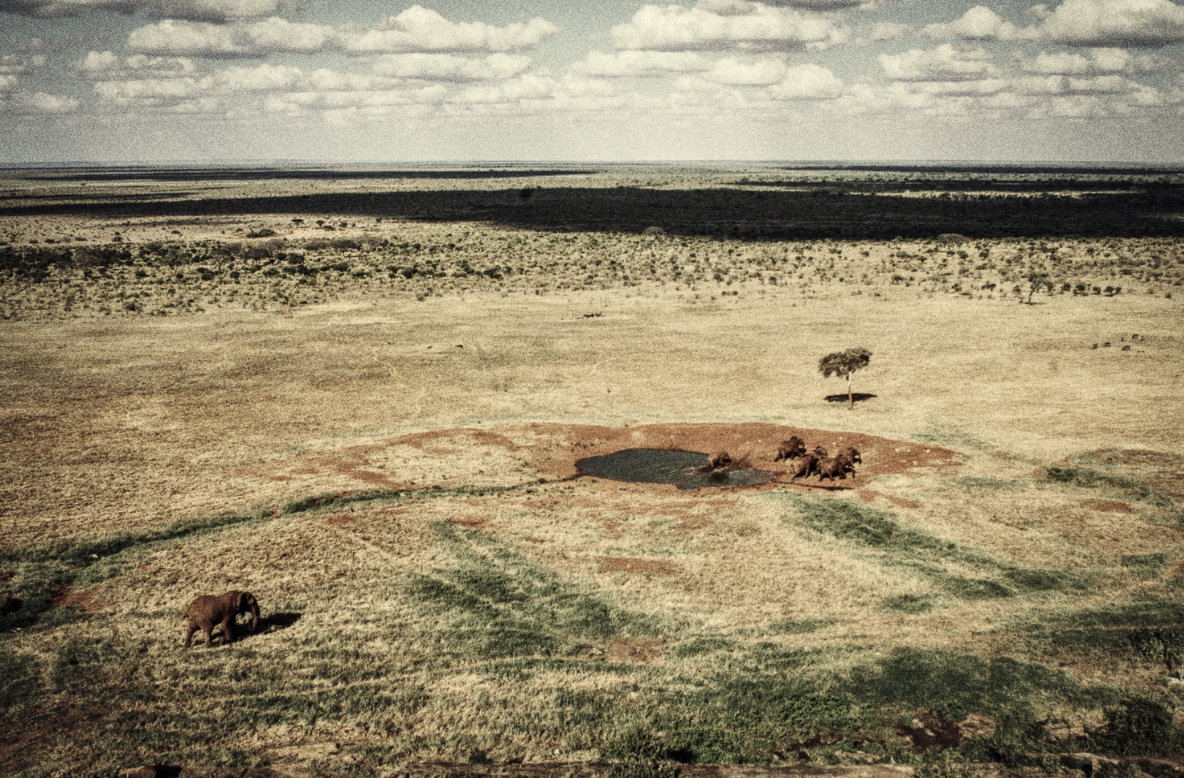
An ode to the old ways of Wild Africa, where remnants of the Pleistocene epoch survive to this day.
Tsavo, “Starv-o” in the local legend, is rugged … wild … untamed.
It is Wild Africa as it ever was, and still is in the fevered imagination of the modern age: a rugged beauty and isolation unequaled. Doum palm sunsets, Dawn of Man sunrises — dusk and dawn,
This is Wa-Kamba country, Ukambani, redoubt of the late adventurer-photographer and raconteur poet Peter Beard, and some of the largest elephant herds on the continent, a place where days blend into night and the darkness comes alive with lions roaring over the parched, thorn-brush plains and tree frog symphonies reverberate along riverbeds into the early hours of morning … remnant holdovers from the Pleistocene.
Tsavo is one of the last wild places on Earth, and it does not suffer fools gladly.
I was one of those fools, years back, and it left an indelible impression on me.
Tsavo East National Park covers an area of 13,747 km² (5,308 sq mi) in Kenya’s southeastern flatlands, not far from where the Indian Ocean meets the Maasai Steppe.
Tsavo West, just across the A109 highway that links Nairobi with the port city of Mombasa, lies within sight of Mount Kilimanjaro, the widest, tallest mountain on the continent. Tsavo West encompasses a further 9,065 km² (3,500 sq mi) of semi-arid thorn scrub and commiphera forest.
In all, Tsavo covers an area roughly equal to that of Israel, or the country of Djibouti, in the nearby Horn of Africa.
At midday temperatures can reach 43℃ (110℉) — too hot for more than a kikoi cloth wraparound and slip-on sandals. Inadvisable footwear in country notorious for its puff adders, black mambas, and spitting cobras.
Beard penned Zara’s Tales, a curated collection of his painstakingly handwritten diaries from more than 20 years of life in the bush, for his then-infant daughter Zara.
Tsavo East was once the home of Waliangulu and Giriama hunters, Beard wrote: beekeepers, trappers, and trainers of bateleur eagles, goshawks, honey buzzards, and lanner falcons. Waliangulus were daring bowmen, fearless hunters of rhino, and some of the biggest, toughest tusker elephants in Africa.
“For the more adventurous visitors,” as the more ‘out there’ tourist brochures say today.
“Walking safaris along the Galana River in Tsavo East National Park offer immersive, guided experiences through Kenya's largest, wildest, and least-visited areas.”
Indeed. Said excursions involve tracking herds of dust-red elephants, hippos, zebras, and oryx on foot, all the while keeping a wary eye out for some of the most fearsome crocodiles on the continent.
This is “high-risk wildlife country,” as the insurance forms say, where reputations count for something. The Great Walk of Africa, a 100-mile multi-day walking expedition arranged by local outfitter Tropical Ice, requires special permits and the accompaniment of armed rangers with the Kenya Wildlife Service (KWS).
Many of these rangers are veterans of the Ivory Wars of the late 1980s and mid 2010s, when KWS anti-poaching units confronted AK-47 wielding shifta bandits from Somalia. The armed gangs were believed to be backed by organized crime syndicates operating across Southeast Asia and the Arabian peninsular, to feed the insatiable ivory markets in China and Japan.
In the event, KWS rangers gained the upper hand over time, aided by a reawakened conservation movement in the West.
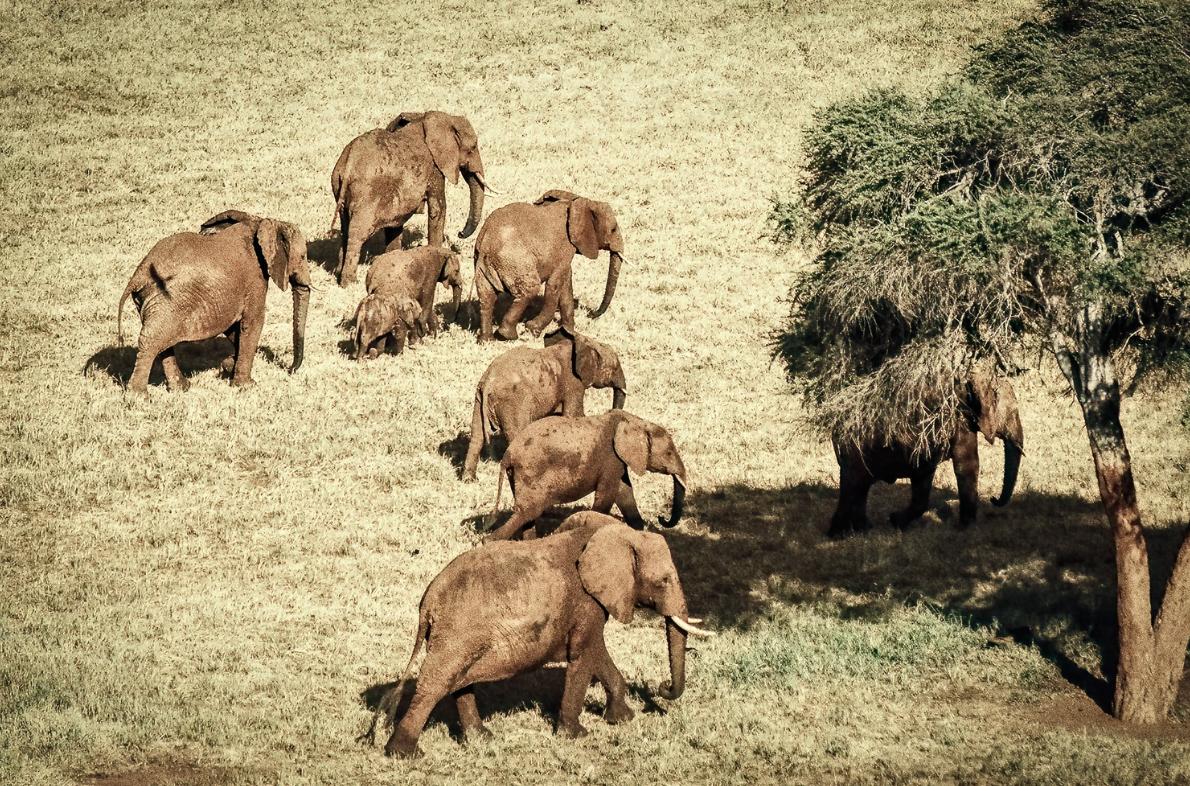
©Alex Strachan / Strachan Photography
The name “Tropical Ice” is intended irony, a knowing nod to the snowcaps of Kilimanjaro to the south.
Kilimanjaro’s Uhuru Peak dominates the horizon owing to its sheer size and distinctive, sloping shape, and its three volcanic cones — Kibo (5,895m), Mawenzi (5,149m), and Shira (4.005m).
“Kili,” as it’s known locally, lies just 330km (200 miles) south of the equator — hence the name Tropical Ice.
With its meandering, dry watercourses, flat arid plains and sparse vegetation, Tsavo provides a glimpse back into the continent’s geological past. This is unspoiled Africa — “Starv-o,” little changed since Beard and the author-poet Romain Gary filled the pages of a double issue of Life magazine in December 1967.
That double issue, featuring Beard’s iconic image of a tusker bull elephant on its cover, was inspired in part by Beard’s book The End of the Game, soon to be reprinted by the Cologne, Germany based art publisher Taschen.
Life’s double issue was a clarion call for African wildlife and its uncertain prospects for a lasting future — “the only wildlife book I know,” one reviewer noted at the time, “that tells the truth.”
Africa’s wild elephant populations, estimated at around 1.3 million in the early 1970s, today ranges somewhere between 415,000 and 470,000 animals. Poaching is an ever present threat.
The Ivory Wars go on …
Over the course of several late afternoons and early evenings, we followed elephants with cameras, viewing the parched plain from the vantage point of the Yatta Plateau, a unique, dramatic reminder of the Pleistocene past, a primordial place where Wild Africa is still breathing its ancient rhythms and remnant herds of elephants pick their way through some of the most rugged, remote terrain remaining on the planet.
The Yatta Plateau’s western edge forms a distinct, continuous cliff wall that looms over a vast panorama of sand rivers and desiccated thorn bush. This is the land of the world’s largest, longest lava flow, where “elephant highways” mark out their territory and home range much as they have for millions of years. Early fossil remains of the Loxodonta genus date back to the Late Miocene, some 6 million years ago. In its modern form, the African savannah elephant is recorded in fossil records from the early Pleistocene, around 2.4 million years ago. .
Tsavo itself, it was said, was home to the wildest of wild dogs, jewelled chameleons, the largest, most menacing scorpions on the continent, the world’s longest spitting cobra, and — at the turn of the 20th century, the infamous Man-eaters of Tsavo.
The man-eaters were a pair of preternaturally large male lions that terrorized construction of “the Lunatic Line,” the old colonial rail line that linked the Indian Ocean port of Mombasa to the railhead of Nairobi in the late 1890s.
And therein lies a tale …
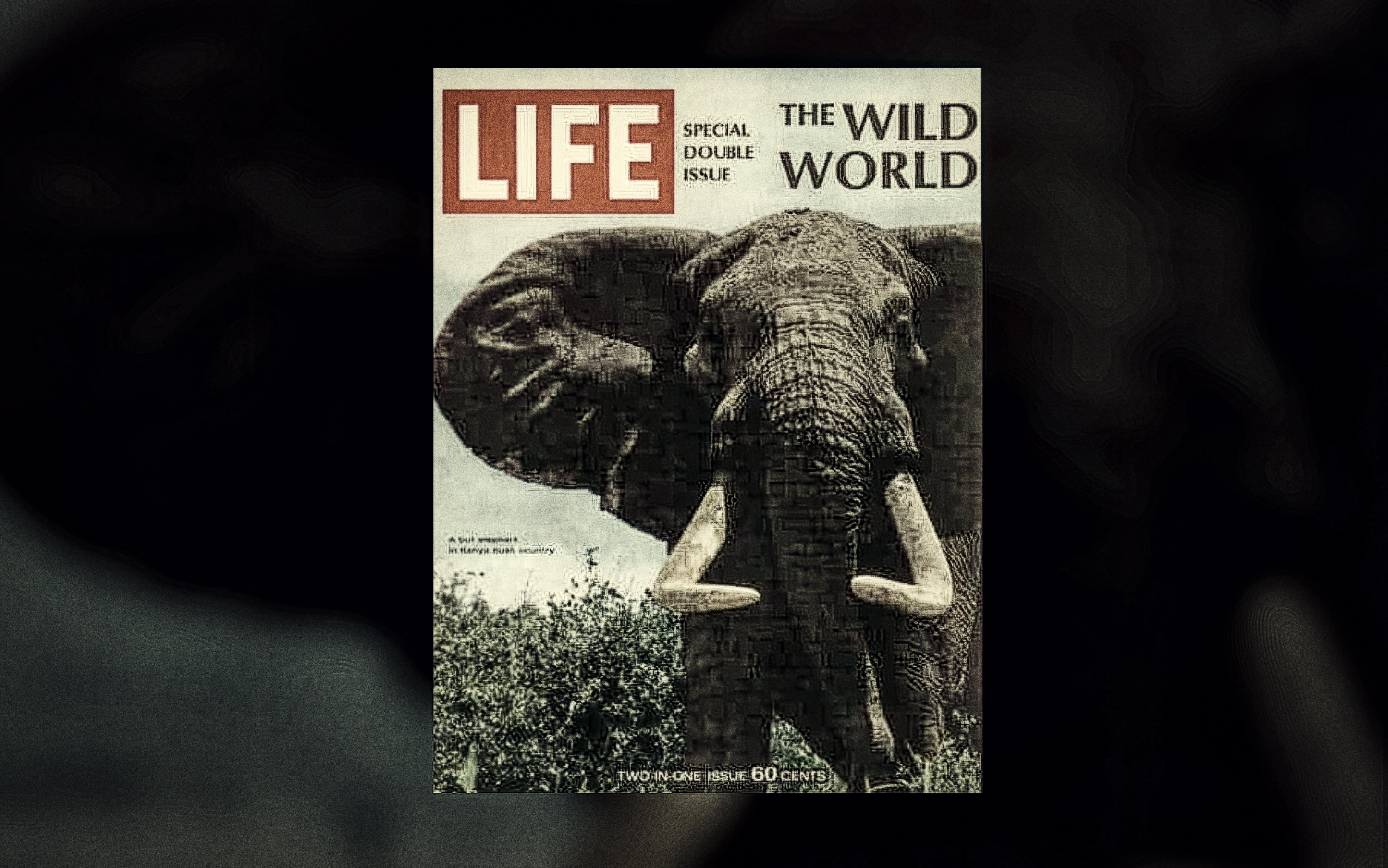
©LIFE Magazine/People Inc. / Photo by Peter Beard